EV Charger Fire in New Westminster: What Every Contractor and Property Owner Needs to Know
EV Charger Fire in New Westminster: What Every Contractor and Property Owner Needs to Know
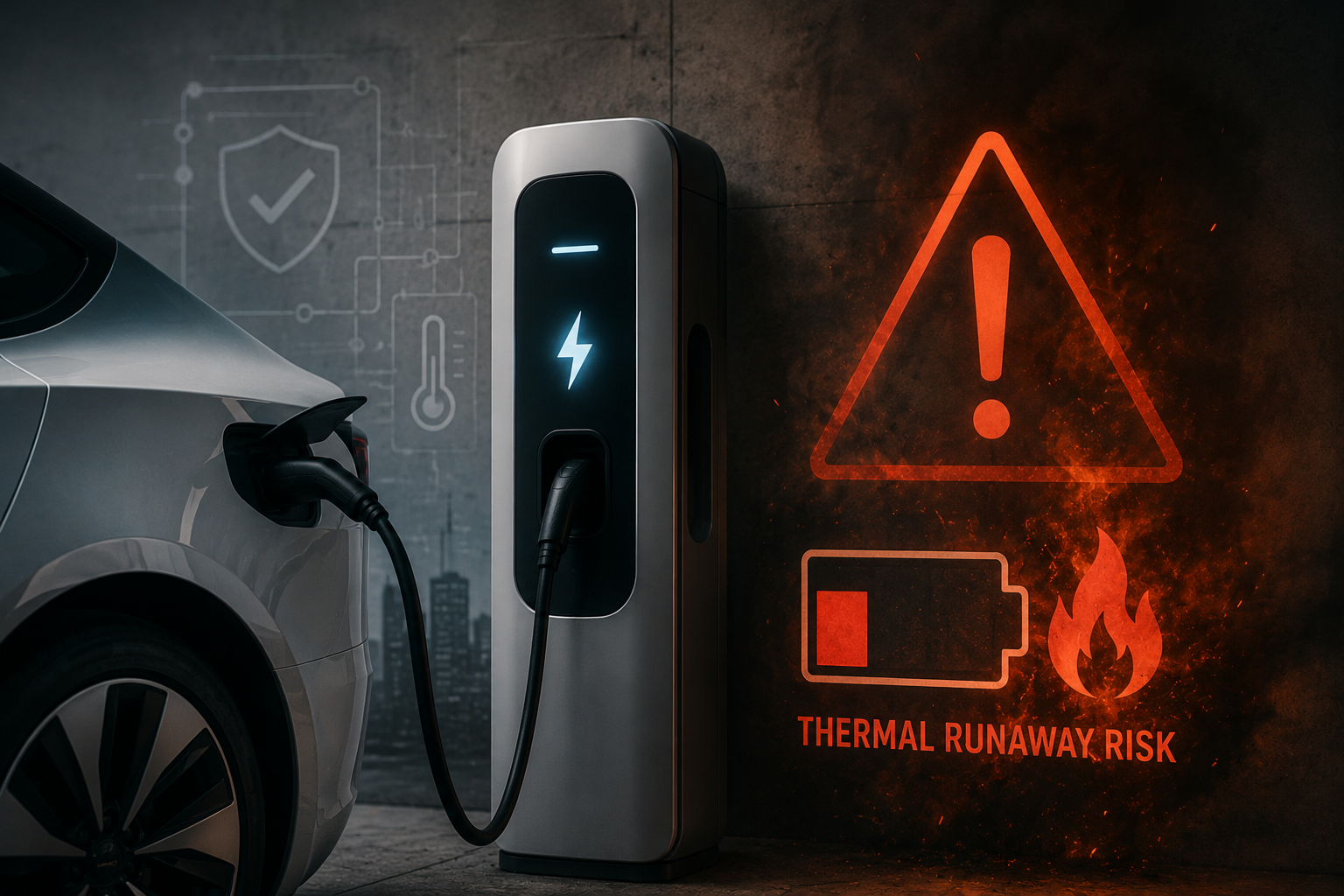
Community News — ESR Electric On October 11, 2025, an EV charging station at a retail plaza in New Westminster burst into flames while nobody was using it. The fire destroyed the charger, damaged surrounding trees, a nearby streetlight, and a vehicle charging at the adjacent stall. A neighboring fast-food restaurant had to evacuate. Toxic emissions from the burning lithium-ion battery spread through the area. Nobody was hurt. But what caused it should concern every contractor, property manager, and strata council in BC.
What Actually Happened
A remote technician in California placed the charger into diagnostic mode on a Friday morning at 10am. Diagnostic mode overrides the safety controls that normally shut the system down if temperatures get too high. The technician never switched it back. Over the next 26 hours, the battery heater ran unchecked. The alerts that should have notified someone of an overheating situation were on silent. Nobody intervened. By Saturday morning the battery had reached 82 degrees Celsius, entered thermal runaway, and caught fire. The charger had no history of issues. The equipment was not defective. Technical Safety BC classified it as an accident caused by human error. A series of small failures compounded quietly over 26 hours until the result was unavoidable.
What Changed After
The manufacturer implemented software updates after the incident. Diagnostic mode now has enforced time limits on how long heaters can run and how long a charger can remain in that state. Critical alert protocols were also updated to ensure overheating notifications actually reach someone who can act on them. These are meaningful fixes. But they came after the fire, not before it.
What This Means for the Lower Mainland
BC has one of the highest EV adoption rates in North America. Charging infrastructure is being added to homes, condos, parkades, and retail plazas faster than most property owners and contractors have experience managing it. EV infrastructure is not standard electrical work. It sits at the intersection of high-voltage DC power, lithium-ion battery chemistry, networked software, and remote access systems. The consequences of something going wrong extend well beyond the charger itself. The New Westminster fire is a useful reminder that the technology is only as safe as the process around it.
What to Ask Before Any EV Charger Installation
If you are a property manager, developer, or strata council planning EV charger installations, these are worth asking your contractor before work begins:
What specific experience do you have with EV charging equipment and battery management systems?
Does your insurance explicitly cover this class of work including thermal events?
What is your protocol for remote diagnostics and who is physically accountable when they occur?
How are critical alerts monitored and by whom?
How do you verify safety system integrity after any software update or maintenance?
A Note on ESR and EV Work
This incident prompted us to review our own insurance coverage for EV charging infrastructure. We are currently working with our broker to ensure our policies explicitly cover EV charging equipment, battery systems, and thermal events. We will not take on EV charging work until that coverage is confirmed. That is not a gap we are embarrassed about. It is the standard we hold ourselves to. Any contractor who cannot confirm their coverage for this class of work before starting it is carrying a risk they may not fully understand. The technology is not the problem. The process around it is.
ESR Electric is a Vancouver-based electrical contractor serving commercial, residential, and industrial clients across Metro Vancouver.