Your House Is About to Become a Data Center And Everyone Wins
Your House Is About to Become a Data Center. And Everyone Wins.
What if the biggest AI infrastructure buildout of the next decade didn't require a single new substation? That's not a thought experiment. It's happening right now in Nevada and Arizona, and if you're in the electrical industry, you should be paying attention. SPAN, the company that reinvented the electrical panel, just announced XFRA, a distributed data center network that turns residential homes into AI compute nodes. NVIDIA is in. PulteGroup, one of America's largest homebuilders, is in. The 100-home pilot launches later this year. And the conditions for this to land in Canada are closer than most people realize.
What Is XFRA, Really?
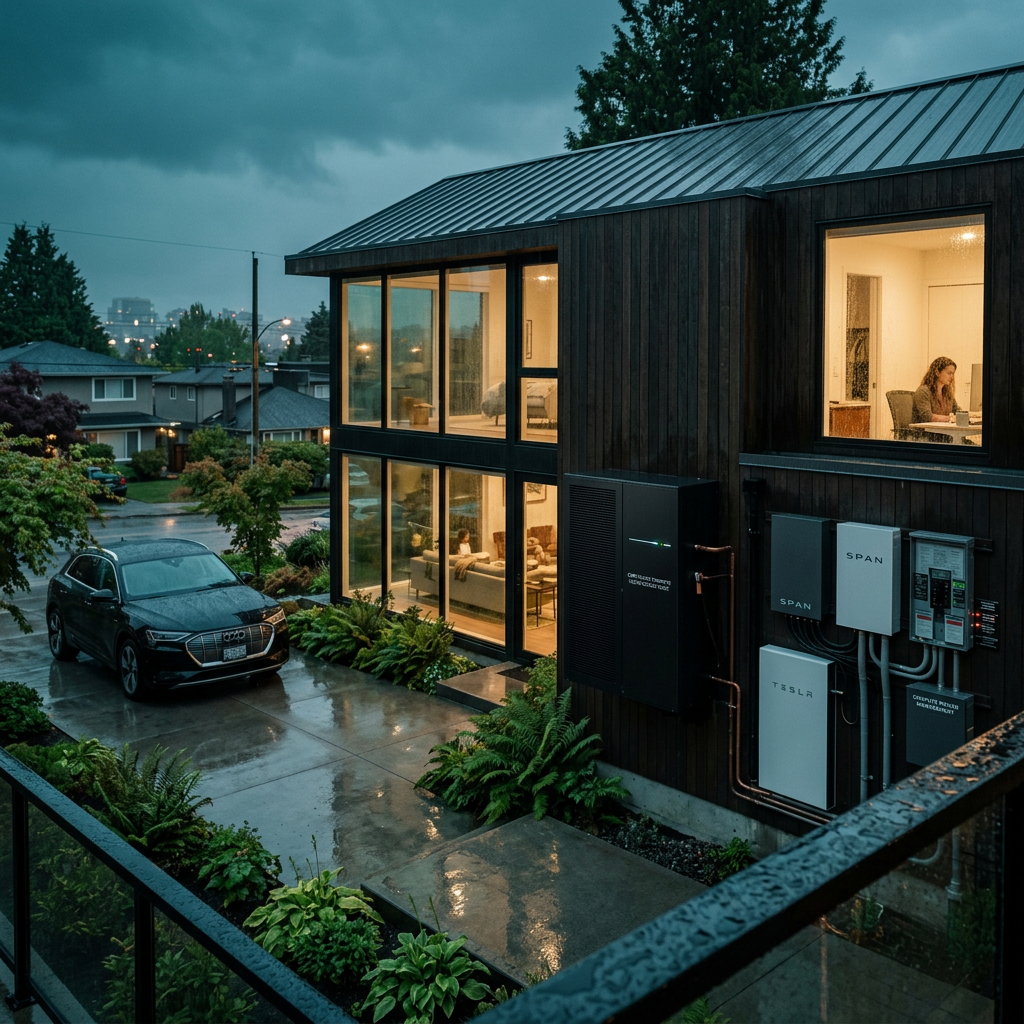
Think of it like renting out a parking spot you're not using. Except the parking spot is your panel's unused electrical capacity, and the tenant is an AI company paying for compute power. Most homes with 200-amp service use roughly 40% of their peak electrical capacity on average. The other 60% sits there, paid for, idle. SPAN's XFRA nodes are liquid-cooled servers packed with NVIDIA Blackwell GPUs that tap into that headroom. A SPAN smart panel monitors real-time usage and feeds the compute node only when the house has capacity to spare. A whole-home battery buffers the load so nothing flickers when an AI workload spikes. One home with 200-amp service contributes roughly 19.2 kW of compute power. Scale that to 80,000 homes and you've got over a gigawatt of inference compute, without pouring a yard of concrete or waiting years for a utility interconnection. Speed to power is the new speed to market. XFRA deploys at roughly $3 million per megawatt in about 6 months, compared to $15 million per megawatt and 3 to 5 years for a traditional 100-megawatt facility.
Who Gets What: The Win for Everyone Involved
Homeowners
- Free SPAN smart panel and a 16 kWh whole-home battery backup
- Electricity and internet bundled at around $150/month, or potentially free in high-value locations
- Backup power during outages, with compute workloads automatically transferring away to keep your lights on
- Optional solar integration This isn't a utility rebate program. It's a material reduction in the cost of running a home.
AI Companies and Hyperscalers
- Instant capacity with no multi-year land, permitting, or utility queue
- Lower latency because compute sits physically closer to end users
- Geographic flexibility with inference workloads distributed where people actually live
Utilities
- Higher grid utilization from infrastructure that already exists
- Deferred capital expenditure with less pressure to build new substations and transmission lines
- Better demand management as constant baseload from compute smooths peak demand curves
- More kilowatt-hours sold over the same physical assets ratepayers are already covering the cost of
Homebuilders
- A genuinely differentiated product in a market where every new subdivision looks the same
- Homes with built-in energy infrastructure and lower operating costs for buyers
- A story to tell that goes beyond granite countertops
Could This Come to Canada?
Short answer: the conditions are nearly perfect. Canada is aggressively pursuing AI data center investment. Ontario, Quebec, Alberta, and BC are all rewriting grid-connection policies to attract hyperscalers. The problem they keep running into is the same one the US faces: interconnection queues that stretch years into the future. Some markets are already seeing delays of seven years or more. XFRA sidesteps that entirely. Here's where Canada has a real edge: Clean baseload power at scale. BC Hydro, Hydro-Quebec, and Ontario Power Generation sit on some of the world's largest renewable hydroelectric resources. AI compute buyers increasingly want carbon-free power and Canada has it in abundance. That's not a minor advantage. It's a deciding factor for where hyperscalers want to put infrastructure. Suburban grid headroom already exists. Canadian homes built in the last 30 years carry the same 200-amp service as American homes and the same idle capacity sitting unused most hours of the day. The physical infrastructure for XFRA already exists in every new subdivision from Langley to Oakville. Behind-the-meter policy is already moving this direction. BC Hydro's $5.3 billion capital plan, Ontario's demand-response pilots, and Natural Resources Canada's distributed energy resource programs are all built around the same core idea: use the grid edge more efficiently rather than building new infrastructure from scratch. XFRA is the most commercially ambitious application of that principle yet, and it fits squarely within where Canadian energy policy is already heading. The regulatory climate is leaning in. Ontario passed Bill 40 in December 2025, legislation that now requires large data centers to obtain Ministerial approval before connecting to the provincial grid, with priority given to projects that serve Ontario's economic interests. That same month, G7 energy ministers met in Toronto and formally endorsed grid modernization and demand-side optimization as coordinated policy priorities. The framework for something like XFRA isn't just possible in Canada. It's consistent with where policy is already pointed. The missing piece isn't policy or power. It's a Canadian homebuilder willing to pilot the model. Once the US proof-of-concept data is public in Q3 2026, expect serious conversations to start happening in Vancouver, Calgary, and Toronto's high-growth corridors.
What This Means for Electrical Contractors
This is where it gets concrete for anyone in the trades. Every XFRA node requires a licensed electrician, not as an afterthought, but as a core part of the installation:
- Smart panel installation and commissioning
- Battery system integration
- Service capacity upgrades because many homes will need work before they can host a node
- Permit coordination with the local authority and utility
- Ongoing inspection and maintenance SPAN's technology handles the software. The physical installation, the safety, the permits, and the grid interconnection still require licensed hands. It always will. An 80,000-home rollout across a single province would represent tens of millions in electrical contracting revenue. The contractors who already understand smart panels, distributed energy systems, and service upgrades won't be starting from scratch when that work arrives. They'll already be there.
The Bottom Line
This isn't science fiction. It's a 2026 pilot with real hardware, real partnerships, and real money behind it. NVIDIA doesn't attach its name to concepts. The question isn't whether distributed residential compute is coming. It's whether your home and your grid will be ready when it does. For Canada, the runway is clear. Clean power. Existing neighborhoods with spare capacity. Federal and provincial policy already pushing exactly this kind of behind-the-meter innovation. All that's missing is a Canadian builder willing to take the first step. When that happens, the electricians who understand this shift won't just be wiring homes. They'll be wiring the infrastructure that powers the next generation of AI.
That's worth getting excited about.